Is a Reverse Osmosis Water Filter System Worth It for Your Home?
A reverse osmosis water filter system is worth it if a water test shows dissolved contaminants such as lead, fluoride, nitrate, or a high level of total dissolved solids that a pitcher or basic carbon filter will not handle. If your only complaint is chlorine taste or odor, a simpler filter is enough and costs less to own.
This guide helps you decide whether RO is the right filter type before you start comparing models.
What does a reverse osmosis water filter system do, and why does tap water taste bad?
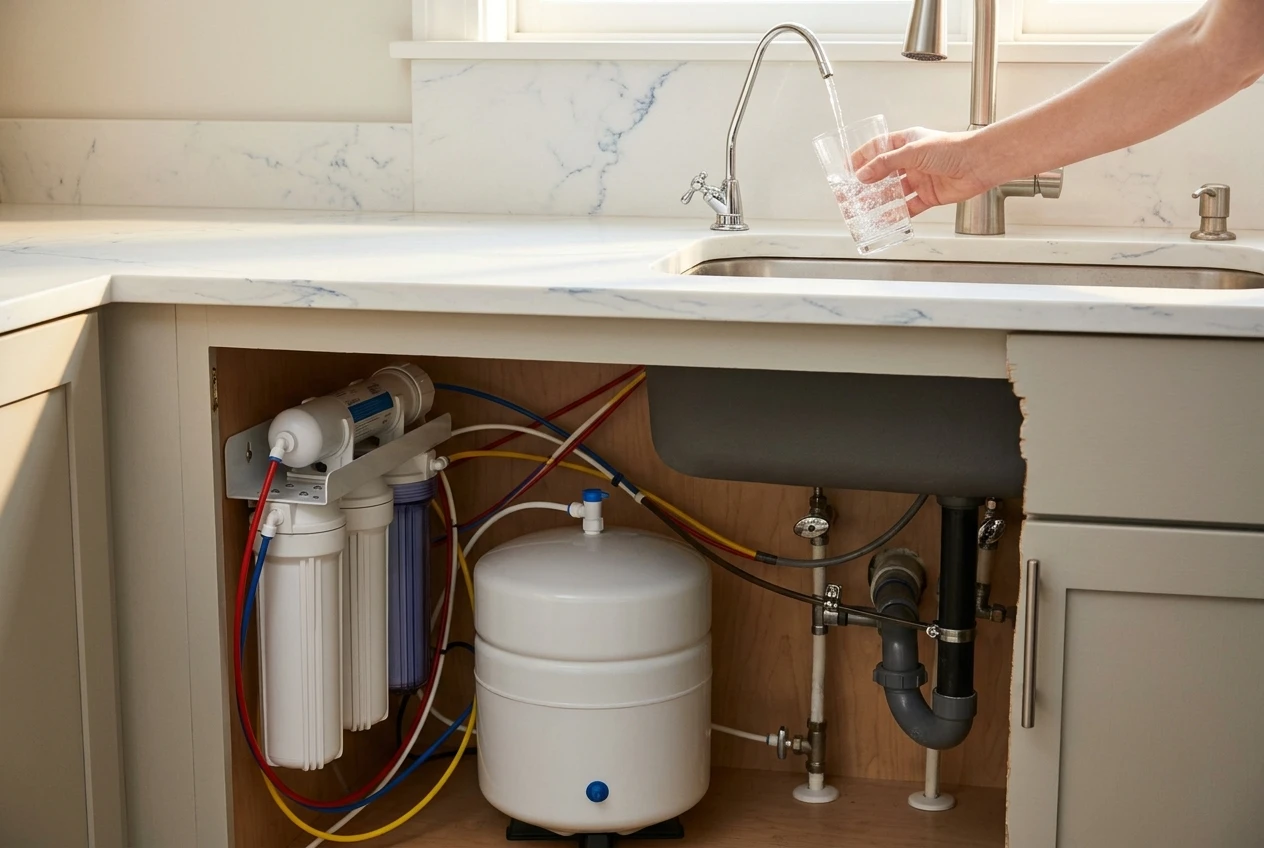
A reverse osmosis system pushes water through a semipermeable membrane that blocks most dissolved substances, while carbon filters before and after the membrane handle chlorine, taste, and odor. The result is a small stream of purified drinking water at a dedicated faucet, and a stream of wastewater that carries the rejected contaminants to the drain.
Tap water tastes bad for a few different reasons, and the cause matters because each one calls for a different filter:
- Chlorine or chloramine from municipal disinfection gives a pool-like smell and taste.
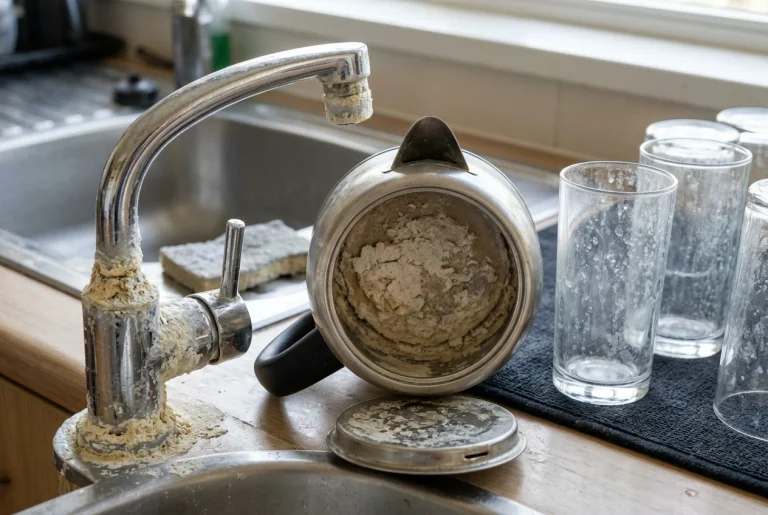
- Dissolved minerals and salts give water a flat, salty, bitter, or chalky taste.
- Sulfur compounds, common in well water, give a rotten-egg smell.
- Iron and manganese leave a metallic taste and stain fixtures.
- Old plumbing can add metallic notes and, in some homes, lead.
Carbon filters are good at chlorine, taste, and odor. They do little against dissolved salts and minerals. The membrane is what sets RO apart: it addresses the dissolved material that carbon cannot grab. That is also why RO makes sense for some homes and is unnecessary for others.
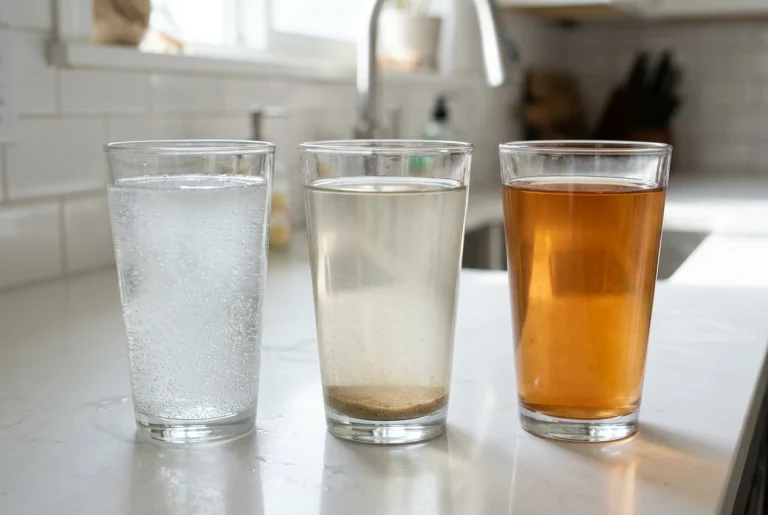
Sediment and cloudiness are a separate problem. If your well water looks murky, start with our guide on how to remove sediment from well water, because sediment will clog an RO membrane quickly if it reaches it.
Do reverse osmosis systems remove fluoride and lead?
Yes, reverse osmosis can reduce both fluoride and lead, which is one of the main reasons homeowners choose it over carbon-only filters. Fluoride is a dissolved ion, and most pitcher filters do not target it. An RO membrane is designed to reject dissolved ions like this.
Lead needs a little more care. Lead usually enters water from old pipes, solder, or fixtures inside your home or service line, not from the water source itself. An RO system at the kitchen sink treats the water you drink and cook with at that tap. It does not treat the water at your bathroom sink or shower.
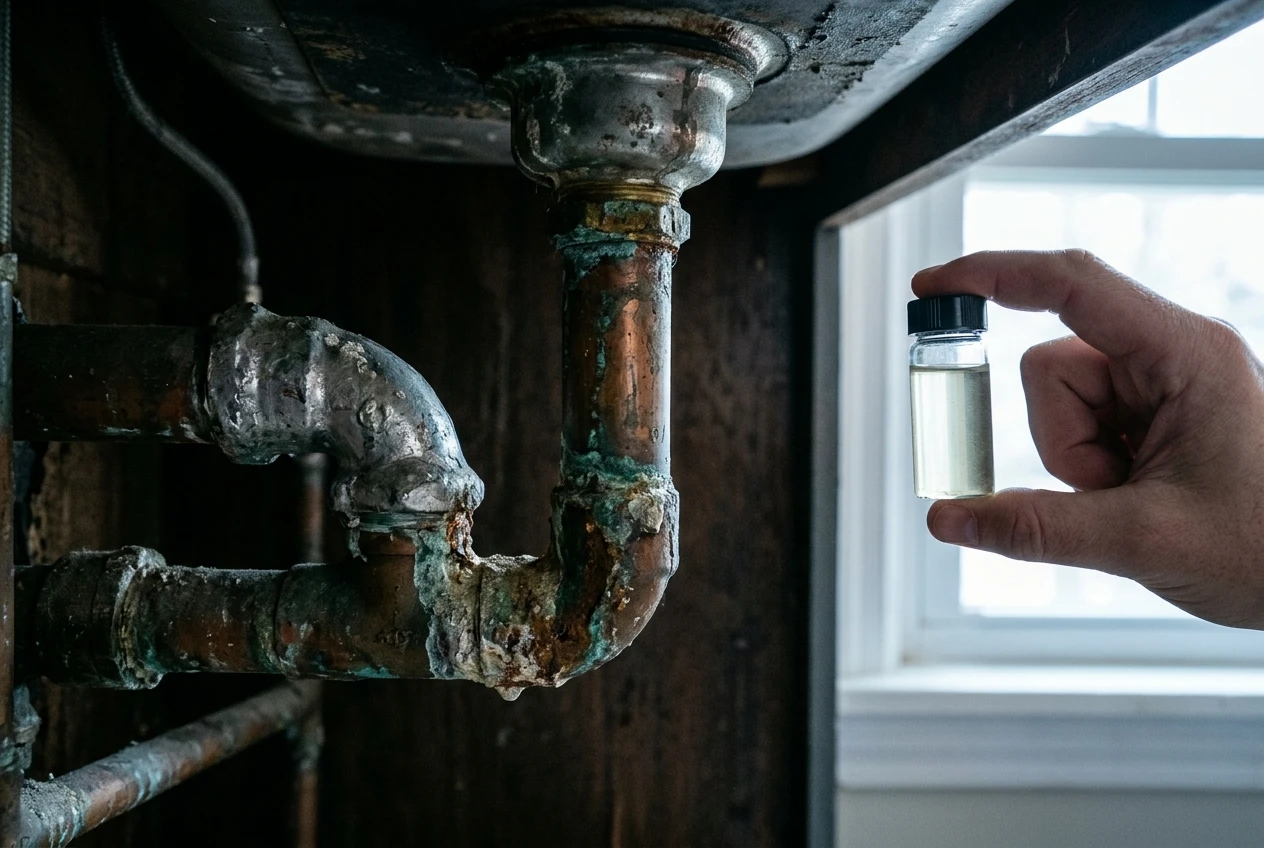
Some pitcher filters are certified to reduce lead, and they are a lower-cost option if lead is your only concern. See our roundup of pitcher water filters that remove lead if that describes your situation.
Before you buy anything for a specific contaminant:
- Get a water test. City water customers can request the annual water quality report from their utility. That report covers the water leaving the treatment plant, not what your pipes add.
- Test your tap. Well owners should test their own water, since no utility does it for them.
- Check the certification. Choose a system certified by a third-party testing body for the specific contaminant you want removed, and read the claim carefully, because certifications are contaminant by contaminant.
How much does a reverse osmosis water filter system cost to own?
The cost of owning a reverse osmosis water filter system has five parts: the unit, installation, replacement filters, the water that goes to the drain, and in some models, electricity. Prices vary a great deal by model and region, so this guide does not quote figures. Use the categories below to build your own estimate from the prices you find.
Cost | What to expect |
|---|---|
Purchase price | Varies by brand, number of stages, and whether the system uses a storage tank or a tankless design with a pump |
Installation | A DIY install costs you time and basic tools; hiring a plumber adds labor to the total |
Replacement filters | Pre-filters, post-filters, and the membrane all wear out on different schedules, and you buy them for as long as you own the system |
Wastewater | RO sends part of the incoming water to the drain, which shows up on a metered water bill |
Electricity | Tankless systems use a booster pump; traditional tank systems generally do not need power |
The recurring cost most buyers underestimate is replacement filters. When you compare two models, look up the price and replacement interval of every cartridge and the membrane, then compare cost over several years rather than the sticker price.
Wastewater is the other factor. Systems differ in how much water they send to the drain for each unit of purified water, and manufacturers publish that ratio. If you are on a metered supply or a well with limited capacity, a more efficient design is worth paying for. If you are on a septic system, ask the manufacturer whether the drain flow is a concern for your setup.
A final cost to consider is remineralization. RO removes most minerals, including beneficial ones like calcium and magnesium. Some homeowners add a remineralizing cartridge afterward. We cover that in how to remineralize reverse osmosis water.
Is a reverse osmosis system worth it compared with a pitcher, countertop, or whole house filter?
A reverse osmosis system is worth it when you have a dissolved contaminant to remove or want the broadest treatment at your drinking tap. For chlorine taste alone, a pitcher or faucet filter does the job for less money and with no plumbing work.
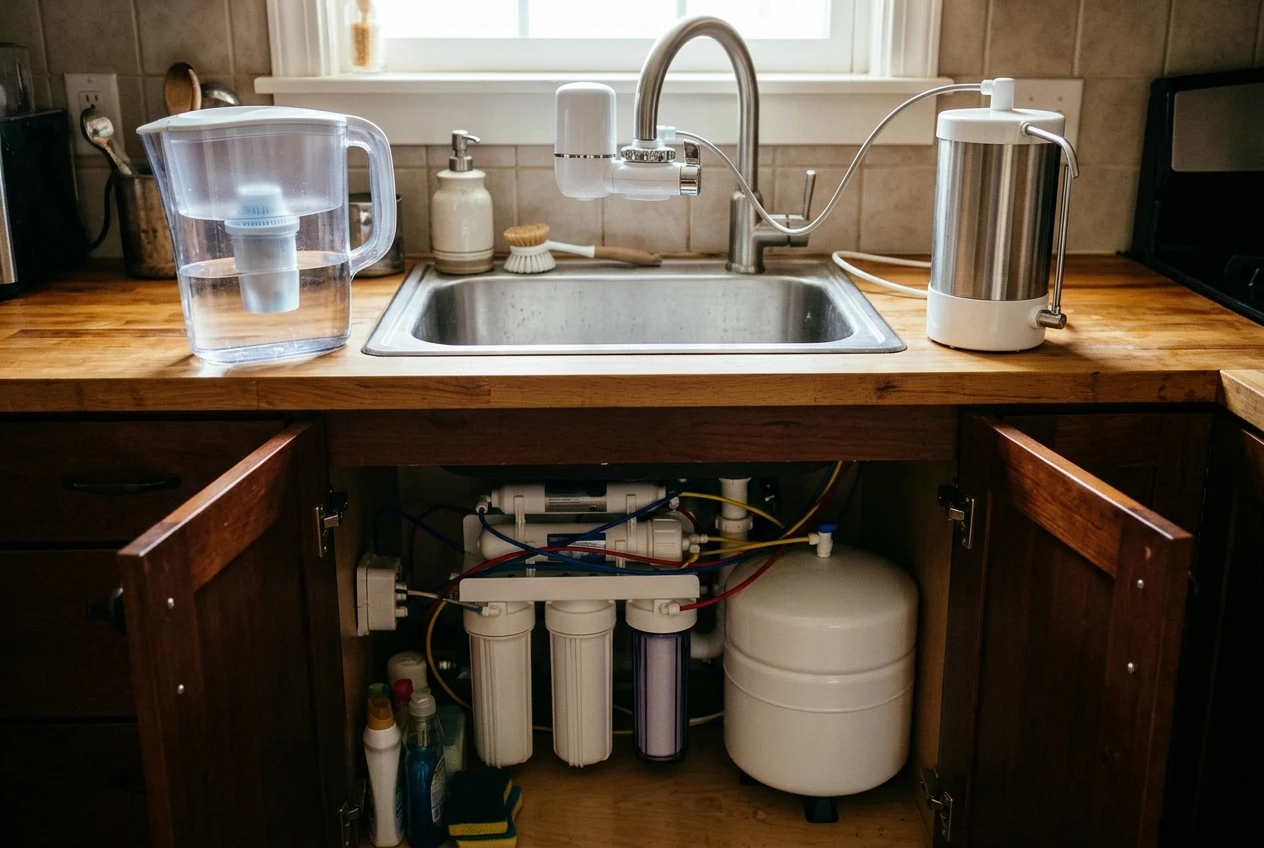
Here is how the main types compare:
Filter type | Best for | Limits |
|---|---|---|
Pitcher | Low-cost improvement in taste and odor; some models reduce lead | Small capacity, frequent cartridge changes, narrower contaminant range |
Faucet-mounted | Simple, renter-friendly, no under-sink work | Slows flow, does not fit every faucet |
Countertop | Higher capacity than a pitcher without plumbing | Takes counter space; coverage depends on the model |
Under-counter, non-RO | Good flow and carbon-based treatment at its own tap | Does not remove dissolved salts and minerals the way RO does |
Under-sink RO | Dissolved contaminants like fluoride and nitrate, plus taste and odor | Wastewater, slower fill, installation, cartridge costs |
Whole house | Treating every tap, protecting pipes and appliances | Different job: usually sediment, chlorine, or iron, not drinking-water polish |
Whole house and RO are not competitors. A whole house system treats all the water entering your home, usually for sediment, chlorine, or iron. RO polishes the water you drink. Many homes use both. Our guide on whole house filters versus point-of-use filters explains how to decide.
If you have an under-counter filter in mind but do not need RO, look at our best under counter water filters that are non-RO.
Choose RO when:
- Your water test shows dissolved contaminants that carbon does not remove.
- You are on well water with issues beyond taste and want one dependable drinking tap.
- You want one system that handles taste and a wide range of contaminants.
Skip RO, or at least pause, when:
- Chlorine taste is the only complaint.
- You rent and cannot modify plumbing.
- You do not want water going to the drain or have no way to run a drain line.
How do you choose a reverse osmosis system for your home?
Choose a reverse osmosis system by matching it to your water test, your sink setup, and your daily water use. Start with the problem, not the product, and only then compare models. Our guide on how to choose a water filter for your kitchen walks through that matching process in more detail.
Consider these points:
- Contaminants on your test. Confirm the system is certified for those specific contaminants.
- Tank or tankless. A tank system stores purified water and usually needs no power, but takes cabinet space. A tankless system is compact and delivers on demand, but needs an outlet for its pump.
- Under-sink space. Measure your cabinet before buying. Garbage disposals, pipes, and shelves can take up room.
- Water pressure. RO membranes work best with adequate incoming pressure, and manufacturers list a minimum. Low pressure can mean slow fill and poor performance, and some homes need a booster pump.
- Wastewater ratio. Compare how much water each system sends to the drain.
- Filter availability. Choose a brand whose replacement cartridges are easy to find and clearly priced.
- Remineralization option. Decide whether you want a mineral cartridge, and whether the system supports one.
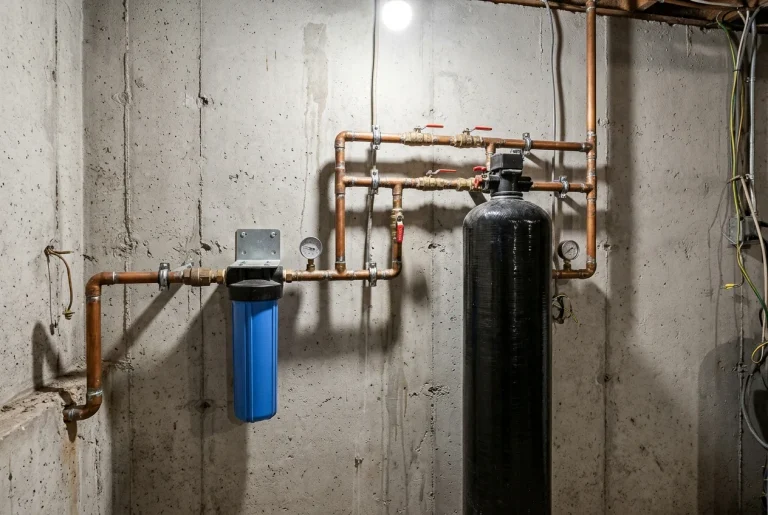
Well water adds another step. Hard water, iron, and sediment can foul an RO membrane early, so these are usually treated first. If hardness is part of your picture, read how to treat hard water from a well before you choose an RO system. A softener upstream often protects the membrane and extends cartridge life.
Also consider what RO does not do. It is not a substitute for disinfection on a private well with bacterial contamination. If you are wondering about microbes, see our article on whether reverse osmosis removes viruses. Well owners with a positive bacteria test should follow the guidance of their local health department.
How do you install an under sink reverse osmosis system?
You install an under sink reverse osmosis system by connecting it to the cold water supply, a drain line, and a dedicated faucet, then mounting the filter assembly in the cabinet. Many homeowners with basic tool skills do this themselves, and others hire a plumber. Always follow the manual that comes with your model, because connection types differ between brands.
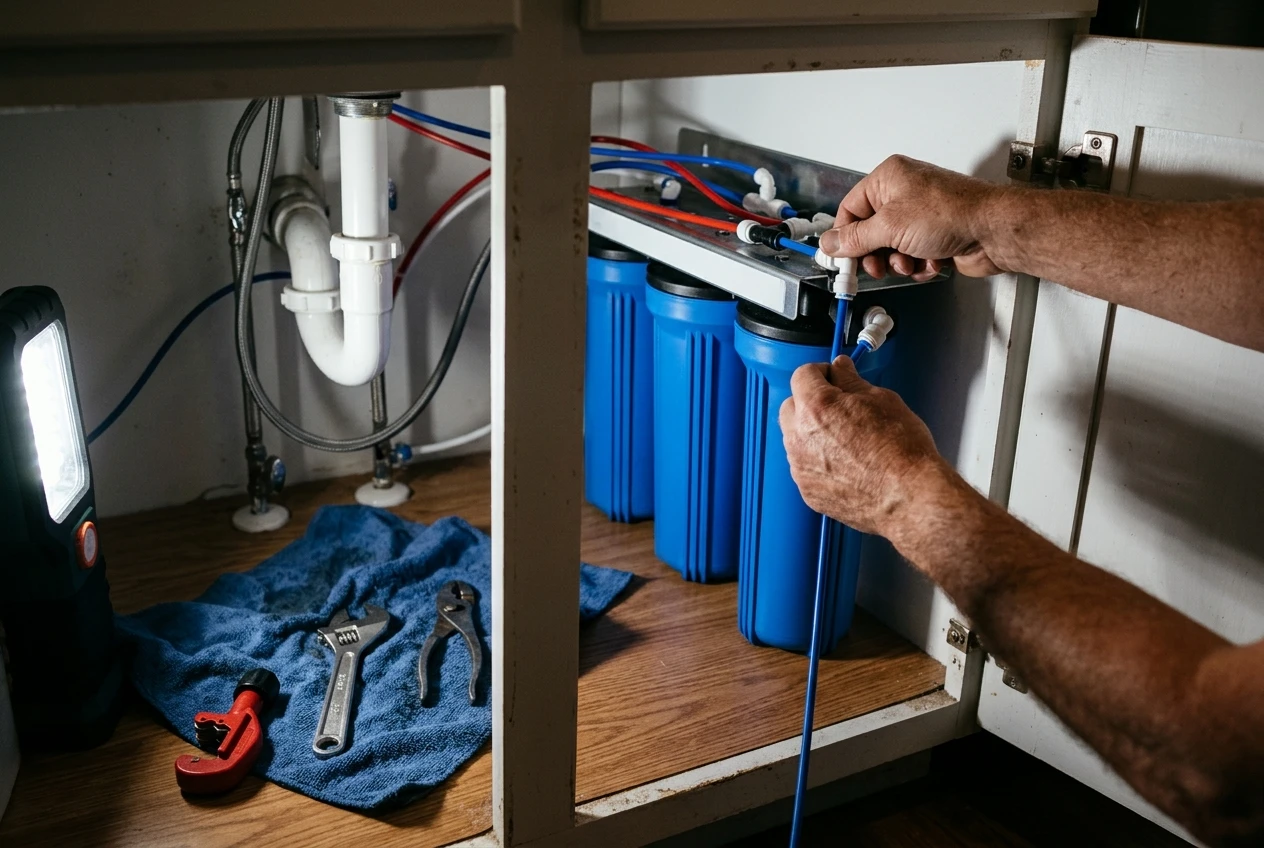
Here is the typical sequence:
- Shut off the cold water supply to the sink and open the faucet to relieve pressure.
- Mount the filter assembly to the cabinet wall or floor, leaving room to reach the cartridges for later changes.
- Install the feed water connection, usually a tee or adapter on the cold supply line under the sink.
- Install the drain saddle on the drain pipe above the P-trap, and connect the drain tubing. This is the step where the wastewater leaves the system.
- Mount the dedicated faucet. Most sinks have a spare hole, but if yours does not, you may need to drill one, which is a reason many people involve a plumber for stone countertops.
- Connect the tubing from the system to the faucet and, on tank models, to the storage tank.
- Turn the water back on and check every fitting for leaks.
- Flush the system according to the manual before drinking. New carbon filters and a new membrane typically need to be flushed first.
Check connections again after a day of use. Small drips at fittings are the most common installation problem, and they are easy to fix when caught early.
If you are also installing other treatment equipment, order matters. For example, if you have a softener, see our guide on whether a water filter goes before or after the softener.
How often should you change the filters?
Change the filters on the schedule in your system’s manual, and sooner if you notice a drop in flow, a change in taste, or a rise in the reading on a total dissolved solids meter. The pre-filters, post-filter, and membrane each have their own intervals, and the manufacturer’s guidance is the number to use, not a general rule.
Here is what each component does and what to watch for:
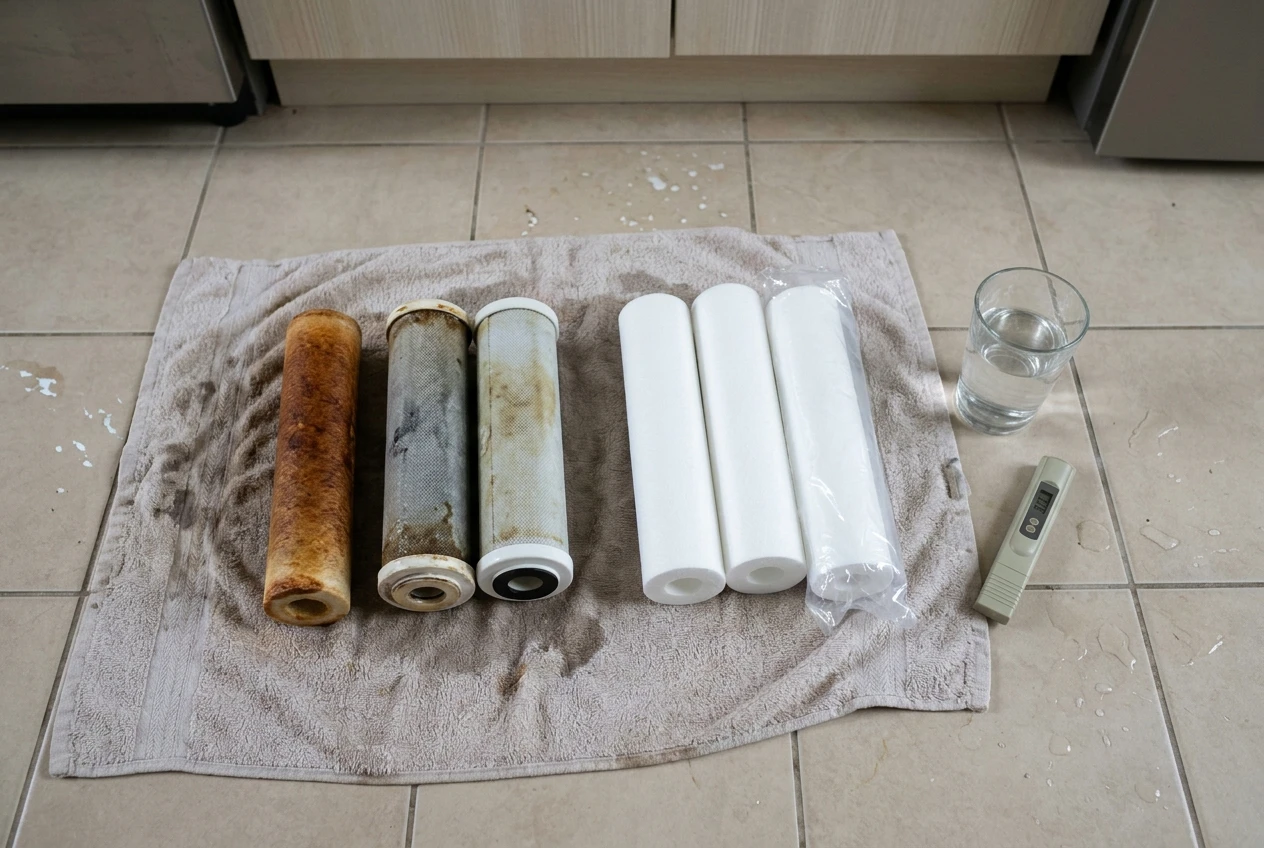
- Sediment pre-filter: Catches particles before they reach the membrane. This is usually the first part to clog, especially on well water, and a clogged one lowers flow.
- Carbon pre-filter: Removes chlorine, which damages many RO membranes. Letting it run past its life can shorten membrane life.
- RO membrane: Lasts longer than the filters, but not forever. Water quality, pressure, and the condition of the pre-filters all affect how long it lasts.
- Post-filter: Polishes taste after the water leaves the storage tank or membrane.
A few habits make the schedule easier to keep:
- Write the install date on each cartridge, or note it on your calendar.
- Buy replacements before you need them so you are never tempted to stretch an overdue cartridge.
- Use a handheld TDS meter to compare tap water and RO water. A shrinking gap suggests the membrane is wearing out. The meter is a rough indicator, not a test for specific contaminants, so keep testing your water when contaminants are your concern.
- Sanitize the system when you change filters if the manual calls for it.
Skipping changes is the most common way an RO system fails to deliver what you paid for. A neglected cartridge does not just stop working; it can reduce flow, change taste, and let contaminants pass.
So, is a reverse osmosis system right for you?
If your water test shows dissolved contaminants, or you want the widest treatment at your drinking tap and are willing to handle installation and regular cartridge changes, a reverse osmosis water filter system is a sound choice. If your complaint is chlorine taste, a lower-cost filter will likely serve you better.
Start with a test, match the filter type to what it finds, and compare total ownership cost rather than purchase price alone. If RO fits, you are ready to look at specific models.
Ready to compare models? See our picks in Best Residential Reverse Osmosis Systems.