
To choose a water filter for your kitchen, start with your water source (well or city), then name the one problem you want fixed: taste and odor, sediment, contaminants, or treatment chemicals. Match that problem to a filter type, and confirm it with a water test or your utility’s report before you buy.
What is the quickest way to choose a kitchen water filter?
The quickest way is to answer three questions in order: where does your water come from, what is wrong with it, and how much of the house needs the fix. The answers narrow the field from dozens of products to one or two filter types.
- Name your source. Private well or public city supply.
- Name your problem. Taste and odor, visible sediment, a specific contaminant, or treatment chemicals.
- Name your scope. Drinking and cooking water at one tap, or every tap in the house.
- Confirm with data. Read your utility’s water quality report or test your well water.
- Pick the type. Pitcher, faucet-mounted, countertop, under-sink or whole-house.
The rest of this guide walks through each step so you can finish with a filter type you can defend, not a product picked from a list of bestsellers.
Is your water from a well or from the city?
Your source decides who is responsible for the water quality, and that changes what you need to do first. City water is treated and monitored by a utility. Well water is not, so testing and treatment fall to you.
City water arrives already disinfected, which is why it often carries a chlorine taste or smell. Utilities also publish a water quality report, so you can read what has been found in your supply without paying for a test. The remaining risks usually come from the last stretch of the journey: older pipes and fixtures in your own home can add metals such as lead, and the utility’s report cannot tell you what your plumbing adds.
Well water comes straight from the ground, with no utility checking it for you. Depending on your area, it can carry sediment, dissolved minerals, bacteria, nitrates or other contaminants that you cannot see, taste or smell. A filter chosen by guesswork is a poor bet here, because the wrong type may do nothing about the actual problem.
If you are on a shared or small private system and you are unsure which category you fall into, ask the system’s operator or your local health department.
What problem are you trying to fix in your kitchen water?
Pick the problem that bothers you most, since different problems need different filter technology. There are four common ones in home kitchens.
Taste and odor
Water that tastes or smells like chlorine, or has a flat or musty quality, is the most common complaint. Activated carbon filters are the usual answer, because carbon is well suited to reducing chlorine taste and many odors. This is the easiest problem to solve and the one where the cheapest filter types are often enough.
Sediment
Sand, silt, rust flakes and cloudy particles show up in the glass or collect at the bottom of a pot. A sediment filter physically strains these out. Sediment is more common with wells and with older pipes, and it matters beyond drinking: particles can clog faucet aerators and wear down appliances.

Well water contaminants
Bacteria, nitrates, heavy metals, high iron or hardness minerals, and agricultural or industrial residues are a different category. No single filter covers all of them. Bacteria call for disinfection, such as ultraviolet treatment or chlorination. Dissolved contaminants like nitrates generally call for reverse osmosis or another specialized process. A plain carbon filter does not address these, and a test tells you which ones apply to you.
City water treatment chemicals
Chlorine is the most familiar, and some utilities use chloramine instead, which is harder to remove than chlorine. Disinfection byproducts and metals from household plumbing also fall under this heading. Carbon-based filters help with many of these, but chloramine and lead need a filter specifically rated for them. Check your utility’s report to learn which disinfectant it uses.
Which filter type fits which problem?
Use the table below to match your source and problem to a starting point. Treat it as a shortlist, not a final answer, and confirm the details with test results.
Your problem | Water source | Filter types that fit | Notes |
|---|---|---|---|
Chlorine taste and odor | City | Pitcher, faucet-mounted, countertop, under-sink | Carbon filtration handles this at any of these types. Choose by convenience. |
Chloramine taste or odor | City | Countertop or under-sink with a filter rated for chloramine | Confirm the rating on the filter itself. |
Lead or other metals from pipes | City | Countertop or under-sink with a filter certified for lead reduction | Test your tap water to confirm the problem exists. |
Visible sediment or cloudiness | Well, or older city plumbing | Whole-house sediment filter, plus a kitchen filter for drinking water | Removing particles at the entry point protects pipes and appliances. |
Bacteria | Well | Whole-house disinfection such as UV, based on lab results | A carbon filter at the kitchen tap does not treat bacteria. |
Nitrates and dissolved contaminants | Well | Under-sink reverse osmosis or another process matched to the test result | The contaminant has to be named by a test first. |
Iron, hardness or sulfur smell | Well | Whole-house treatment | These affect every tap, fixtures and laundry included. |
Pitcher, faucet-mounted, countertop or under-sink: how do they compare for daily kitchen use?
Each type trades convenience against capacity and the range of problems it can handle. Here is how they differ in daily use.
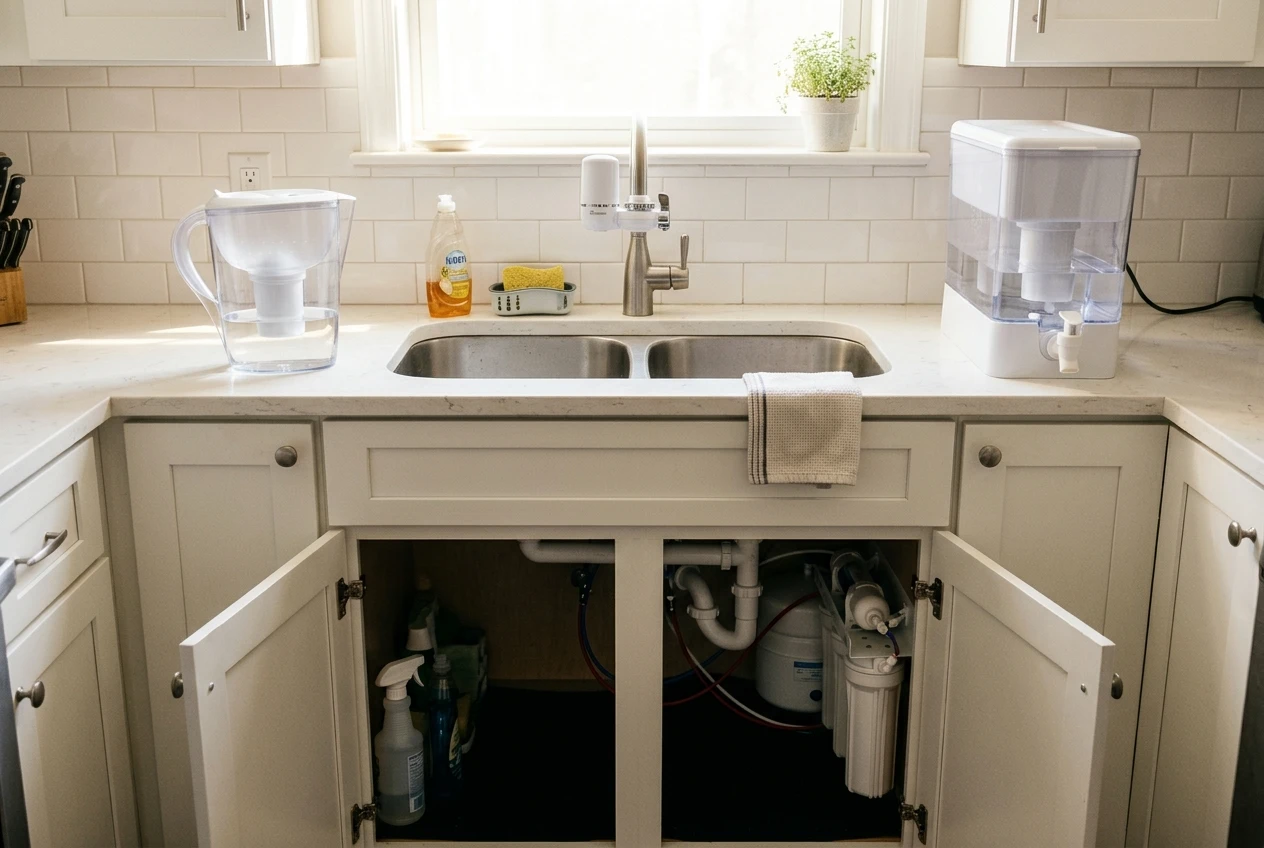
- Pitcher: Needs no installation and suits renters or anyone with one simple concern, usually taste and odor. You refill it by hand, so it works best for drinking water and less well for filling large pots. It sits in the refrigerator, which takes up shelf space.
- Faucet-mounted: Attaches to the end of the faucet and filters water on demand. It installs in minutes without tools in most cases, though it does not fit every faucet style. It suits people who want filtered water for both drinking and cooking without refilling a container.
- Countertop: Sits next to the sink, usually connects to the faucet or holds water you pour in, and often uses more filter media than a pitcher. It takes counter space but needs no plumbing work. It is a reasonable middle option when you want better filtration than a pitcher without cutting into the cabinet.
- Under-sink: Installed beneath the sink and, in most setups, delivers water through its own tap or the existing one. It handles a wider range of problems, including reverse osmosis systems for dissolved contaminants. It needs more installation effort and cabinet space, and the filter cartridges need regular replacement.
- Whole-house: Installed where water enters the home and treats every tap. It is the right place for sediment, iron, hardness and well disinfection. Most households still pair it with a kitchen-level filter for drinking water if a specific contaminant needs targeted removal.
The pattern is consistent: the more specific and serious the problem, the further toward under-sink and whole-house systems you move.
Do you need to test your water before you buy?
Yes, if you are on a well, and it is worth doing on city water when you have a specific concern. A test turns a guess about your water into a list of contaminants, so you pay for treatment that matches what is actually there.
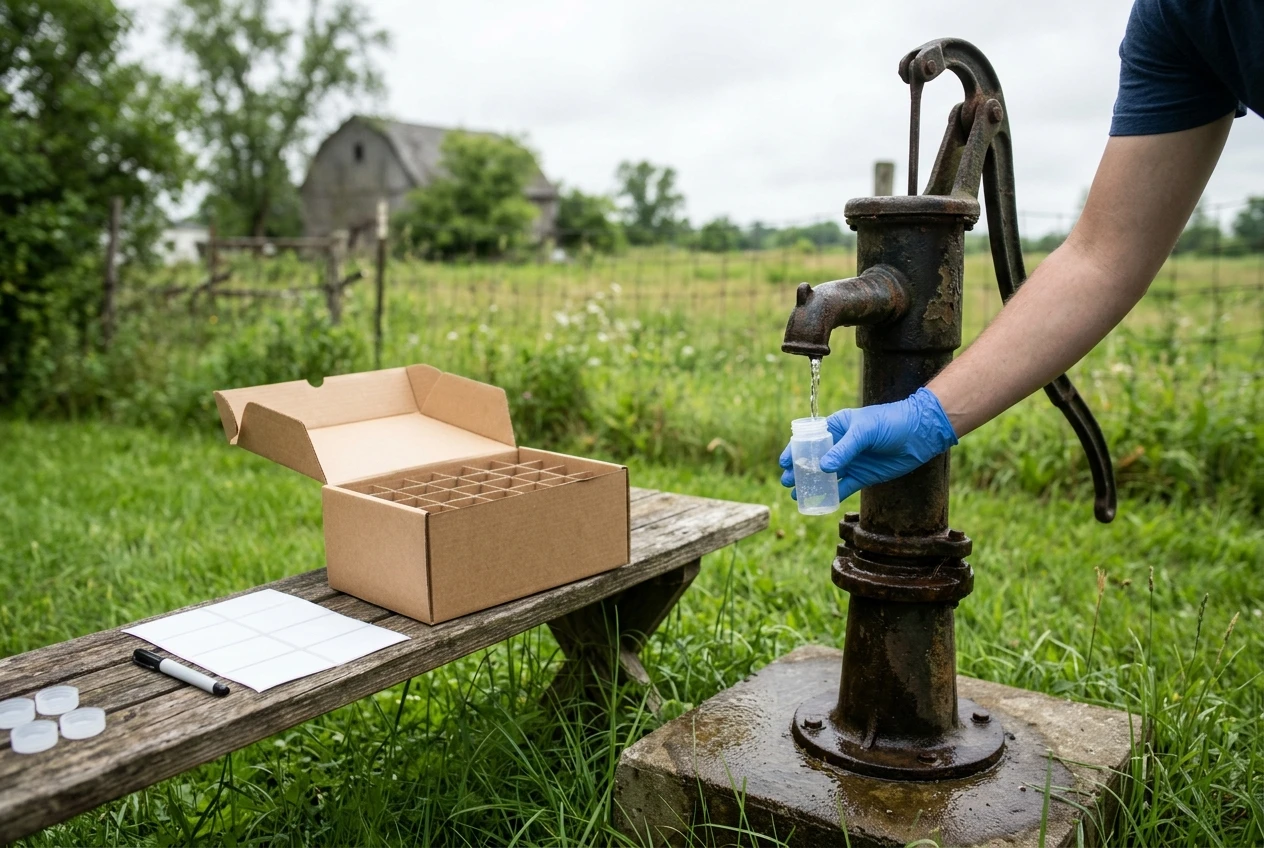
For a private well, use a certified laboratory and ask which tests suit your area. Your local health department or county extension office can often point you to approved labs. Retest periodically and after any change, such as flooding or nearby construction, because well water can shift over time.
For city water, start with the utility’s annual water quality report, which is free. It covers the water as it leaves the treatment system. If you suspect your own plumbing, for example in an older home, a tap test for metals can show what the report cannot.
Do the test before you shop. A filter bought first and tested against later can turn out to be the wrong type entirely.
What should you check before you buy a specific filter?
Once you know the type, check the individual product against the problem you identified. These points apply to any filter, regardless of brand.
- Certification for your contaminant. Look for independent certification that names the exact contaminant you want reduced, such as lead or chlorine. A general claim of “cleaner water” tells you nothing. Check the certifier’s public database to confirm the listing.
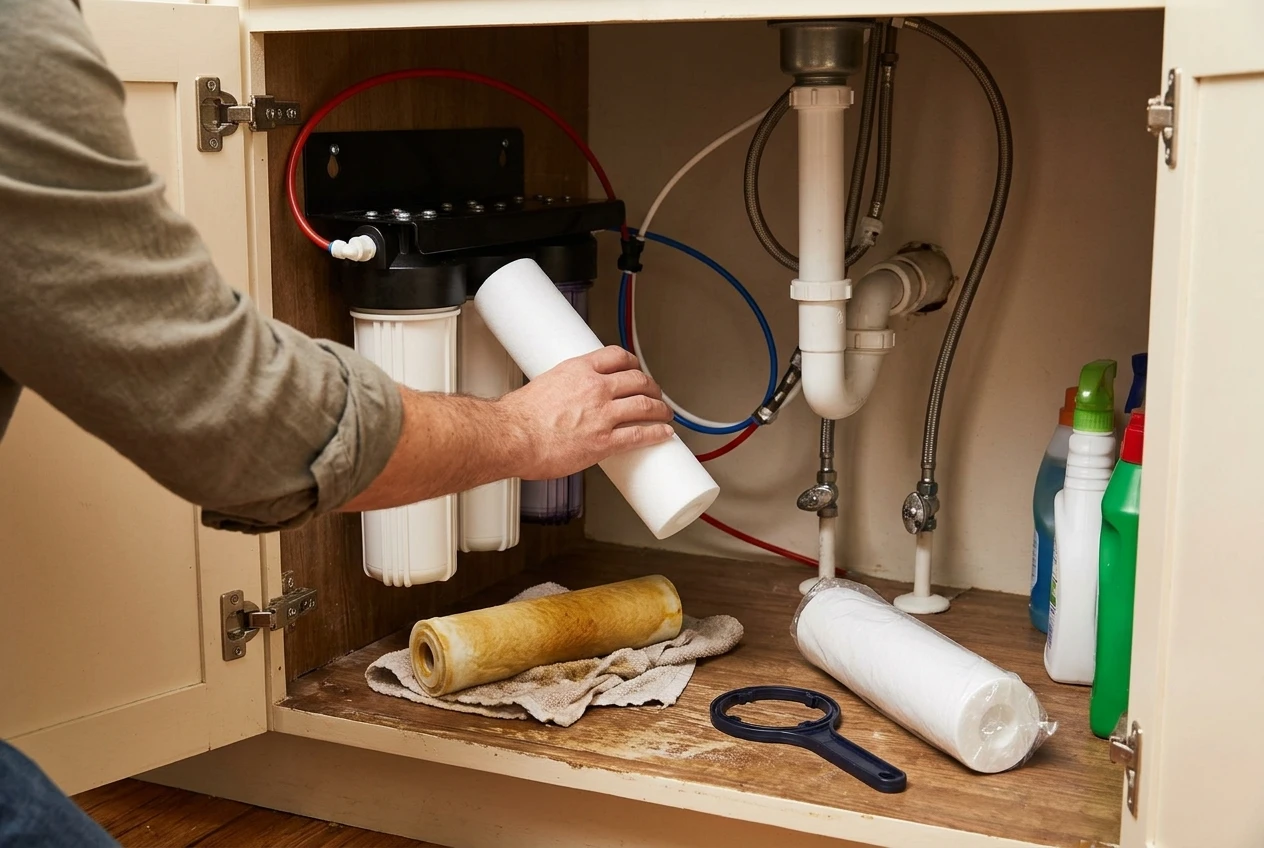
- Replacement filter availability and schedule. A filter that is not changed on time stops working properly. Find out how often cartridges need replacing and whether they are easy to get.
- Ongoing cost. Compare the cost of replacement cartridges over time, not only the purchase price.
- Fit and installation. Confirm it fits your faucet, sink cabinet or plumbing, and decide whether you will install it yourself or hire someone.
- Water you actually use. Think about how much filtered water your household uses daily for drinking and cooking, and choose a type that keeps up with that.
- Maintenance you will really do. A simple system you maintain beats a more capable one you neglect.
Which situation sounds like yours? Quick picks by scenario
Find the scenario closest to yours and use it as a starting point.
- City water, chlorine taste, renting or on a small budget: A pitcher or faucet-mounted filter is a sensible first step. It handles taste and odor with no installation.
- City water, you cook and drink a lot of tap water: A countertop or under-sink filter gives you filtered water on demand without refilling.
- City water in an older home, worried about lead: Test your tap water, then choose a countertop or under-sink filter certified for lead reduction.
- City water that uses chloramine: Pick a filter whose label states it reduces chloramine, and check this before buying.
- Well water with sediment or cloudiness: Start with a whole-house sediment filter at the point of entry, then add a kitchen filter if you still want to improve drinking water.
- Well water with a positive bacteria result: Use disinfection such as UV treatment suited to the lab results, and follow your health department’s guidance on drinking water in the meantime.
- Well water with nitrates or other dissolved contaminants: An under-sink reverse osmosis system is a common route, once a test confirms what needs removing.
- Well water with iron, hardness or a sulfur smell: Whole-house treatment addresses these at every tap, not just the kitchen.
Once you know which type fits your kitchen, browse the filter reviews on the site, starting from the homepage.